
Tesla Flying Car vs Badminton Shuttle: Who Really Mastered Flight?

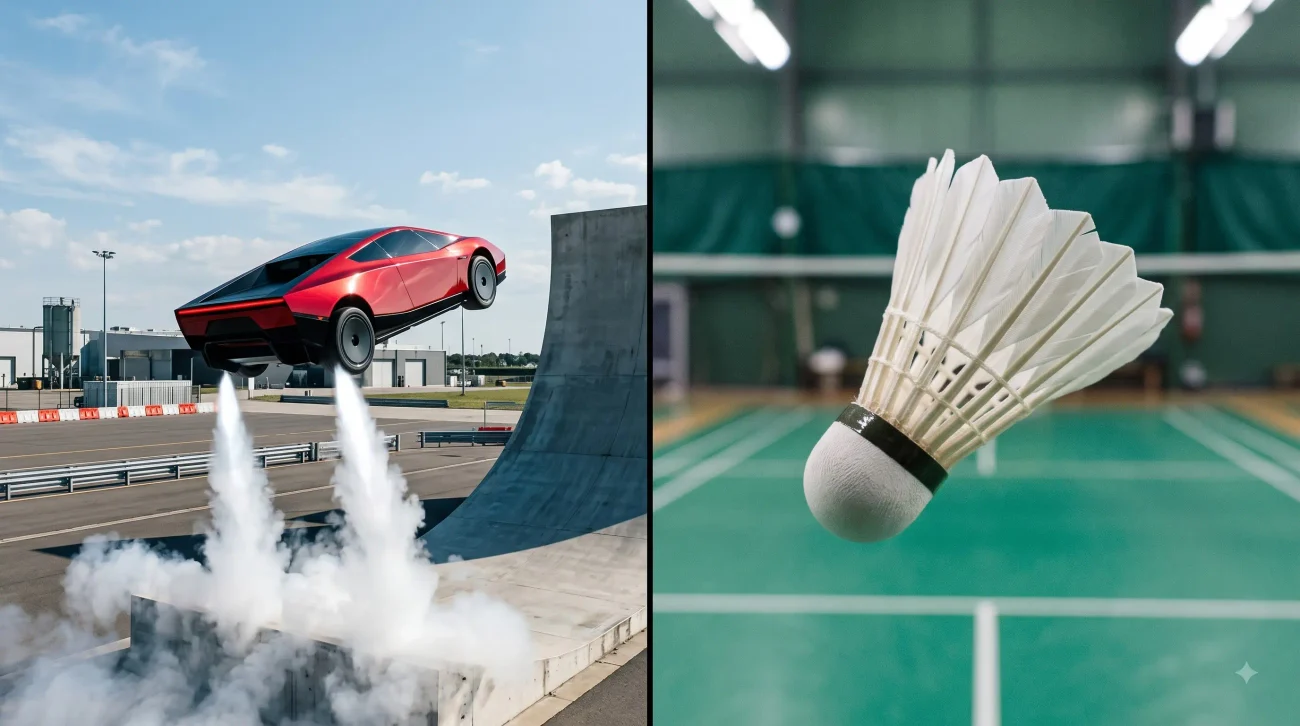
Last week, the whole internet was talking about one thing. A Tesla car jumped into the air, rolled over, and landed back on its wheels. People called it the first flying car.
Walk into any badminton court in Doha, and you will hear a different reaction. Players just smile. Because for more than a century, a small object made of cork and goose feathers has been flying, flipping and landing perfectly, thousands of times a day. We call it a shuttlecock.
So let’s compare them. How did Tesla make a car fly? How does a shuttle fly? And what can a badminton player learn from both? Let’s go step by step, in simple words.
What Tesla Actually Showed
On October 15, 2026, Tesla unveiled its new Roadster at a SpaceX test site in McGregor, Texas. Elon Musk wrote soon after that the future does have flying cars.
Here is what happened in the demo. A Roadster prototype with no driver drove up a curved ramp, shaped like half of a roller coaster loop. It then left the ramp, flew over a line of other Tesla cars, and landed softly using air jets. In another stunt, the car did a roll in the air.
Now, an honest note. This is not a flying car like a plane or a helicopter. It is a very short, controlled jump. Even the reviewers asked if it really counts as flying. And Tesla itself says the flying version is not approved for public roads. Musk also said it is “not necessarily a safety-optimized car.”
Still, it is a big engineering show. And the way it works is interesting.
How Tesla Made the Car Fly
The magic word here is “cold-gas thrusters”. Let’s break it down.
1. Compressed air in strong tanks
Think of a balloon. When you blow it up and let it go, it shoots around the room. The air inside was pushed in with pressure, and when it escapes, it pushes the balloon the other way.
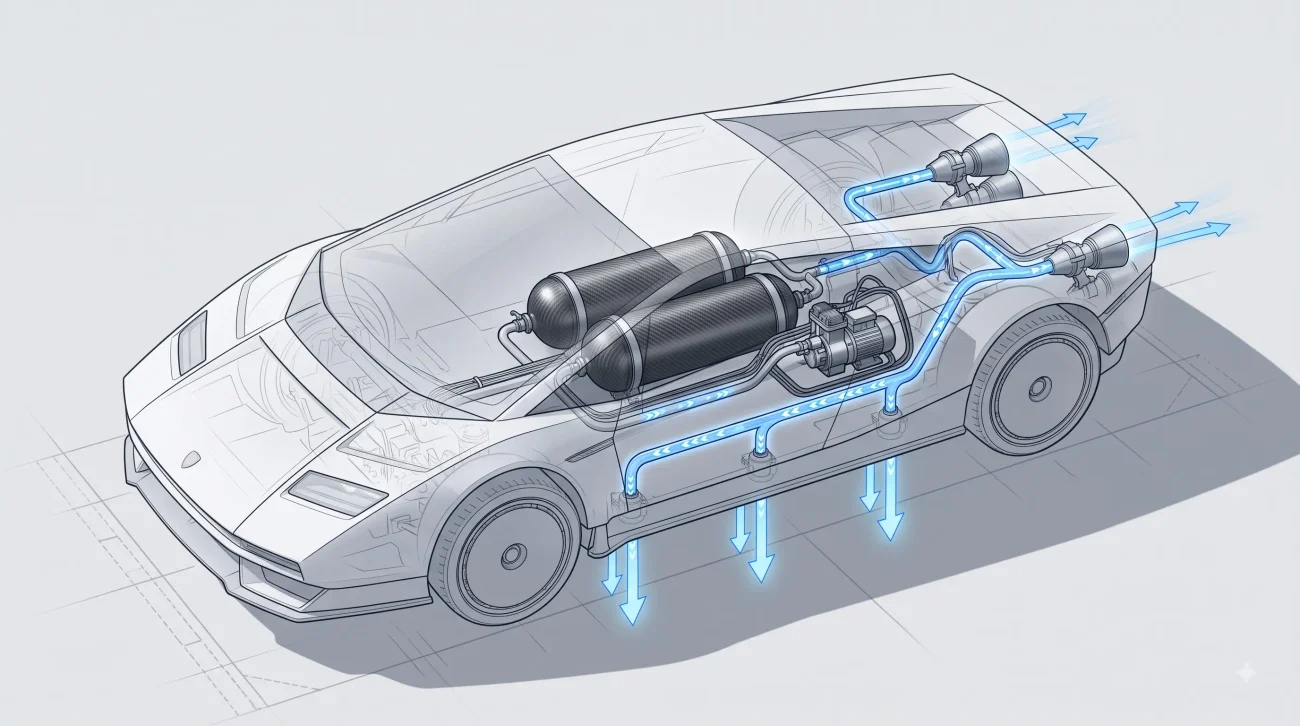
Tesla uses the same idea, but at a much bigger level. The car carries strong air tanks made of carbon composite. Reports say there are two high-pressure tanks. They store air at very high pressure, ready to be released in a second.
2. Nozzles that turn pressure into push
The air does not just leak out. It goes through special nozzles that point in set directions. Reports describe about ten thrusters around the car. Four point backward to push the car forward fast. Six point downward to lift the car and control it in the air.
This is the same family of technology that SpaceX uses to turn and steady its spacecraft in space. It is called a cold-gas thruster because nothing burns. There is no fire and no fuel. Only stored gas rushing out.
3. An air pump that refills the tanks
You may ask, what happens when the air is finished? The system uses an electric pump to refill the tank. When Tesla first talked about this idea in 2018, it described exactly that: an electric pump that recharges the air tank. This new Roadster is described as having self-refilling thrusters.
So in simple words: electric pump fills the tank, tank feeds the nozzles, nozzles push the car.
4. Suction fans that hold the car down
Here is a part many people miss. The Roadster also has a strong fan system under the car. It pulls air out from under the body and creates suction. Tesla claims about 2 g of suction. That is how the test car could even stay stuck to a ramp while upside down.
Suction keeps the car glued to the ground. Thrusters kick it into the air. Two very different tools in one machine.
5. The numbers Tesla claims
Tesla says the thrusters give 4 to 5 times the force the tires can give. It claims a 0 to 60 mph time of about 0.81 seconds for the thruster version. One report says the thrusters make over 80 kilonewtons of force. These are company claims from a demo, so treat them as claims until real owners test them.
6. Three versions, one real catch
Tesla plans three versions. The Performance version has the fans and active aerodynamics but no thrusters. The Thrust version adds rear thrusters. The Rocket version is the flying one. It has a single seat, it is invite only, and it is not approved for public roads. Production is targeted for 2028.
So the honest summary is this: Tesla has built a very cool jump machine. It is not yet something you will use to fly to work.
Now Meet the Original Flyer: The Shuttlecock
A shuttlecock has no battery, no tank and no motor. But look at what it does. When a top player smashes it, it leaves the racket at a crazy speed. The official fastest smash record is over 560 km/h. That is faster than many trains and close to the speed of a small airplane at takeoff.
And then, within a blink, it slows down to a gentle fall. Why? Because it is built for exactly that. Every part of it has a job.
The cork head
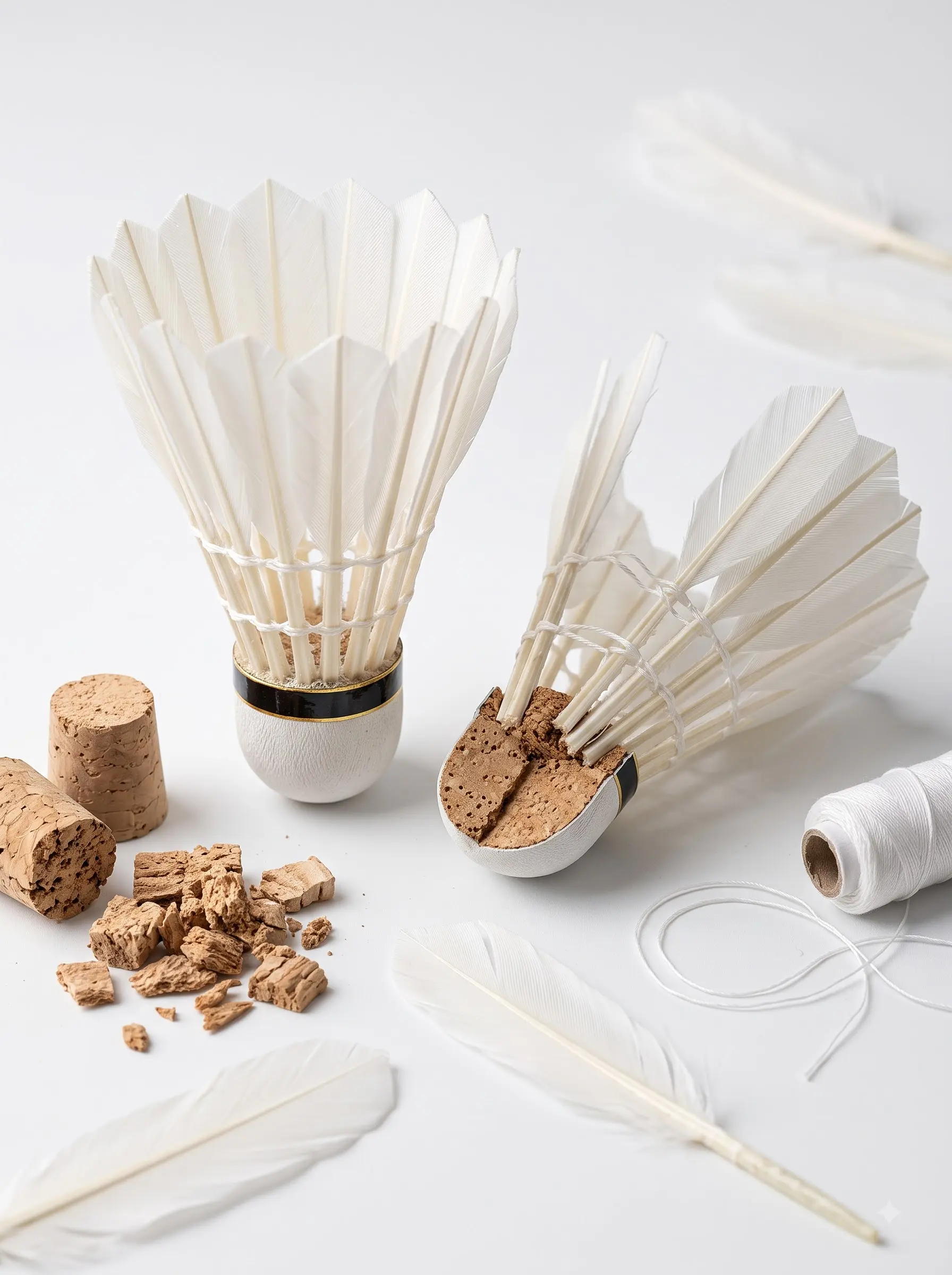
The base of a shuttlecock is the heavy part. It is usually made from natural cork, which is the bark of the cork oak tree. Most high quality cork comes from countries like Portugal and Spain. The cork is covered with a thin layer of leather.
The cork is the “engine room” of the flight. Because it is heavy compared to the rest, it always leads the way. No matter how you hit the shuttle, it will turn and fly cork first.
Here is something every player in Qatar should know. There are two kinds of cork bases. Some brands sandwich foam, such as polyurethane, between thin cork pieces. Others use a single piece of natural cork. The foam type loses its shape after use. The single natural cork piece changes very little. That is why better shuttles use natural cork, and why they last longer and feel more consistent.
The feather skirt
The skirt of a standard shuttle has 16 feathers. Goose feathers are the first choice for top quality shuttles because they are strong, light and flex well. Duck feather shuttles also exist. They are cheaper but are usually less durable.
Makers also match the feathers carefully. The feathers come from the same side wing so that they are the same shape, and each one overlaps its neighbour. This is why a good shuttle is perfectly round in the air. A mix of feathers makes a shuttle that wobbles.
The feathers are trimmed to a set length, around 62 to 70 mm, then fixed into the cork with glue and tied with thread. Then each shuttle goes through quality checks. Under Badminton World Federation rules, a feather shuttle should weigh about 4.74 to 5.50 grams. That is lighter than a coin.
The plastic (nylon) shuttle
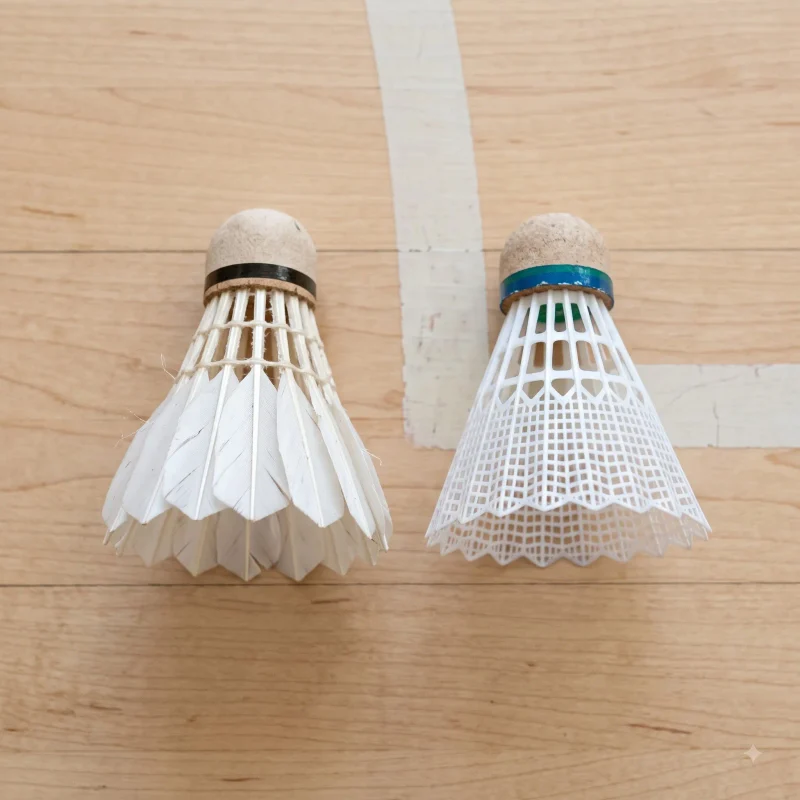
Not every shuttle uses feathers. Nylon or plastic shuttles have a skirt made from synthetic material, often with a cork or foam head. They are cheaper and last much longer. That is why schools, beginners and casual outdoor players love them.
The trade off is feel. Feather shuttles give better touch and a more natural flight, so serious tournaments use them. Nylon shuttles are tougher but behave a little differently in the air. In Asia and the Gulf, many serious clubs still want feathers for training, because the match shuttle should feel like the training shuttle.
The Physics: How a Shuttle Flies Without Any Power
Now the interesting part. French scientists studied the shuttlecock with high speed cameras and found three things.
1. The flip
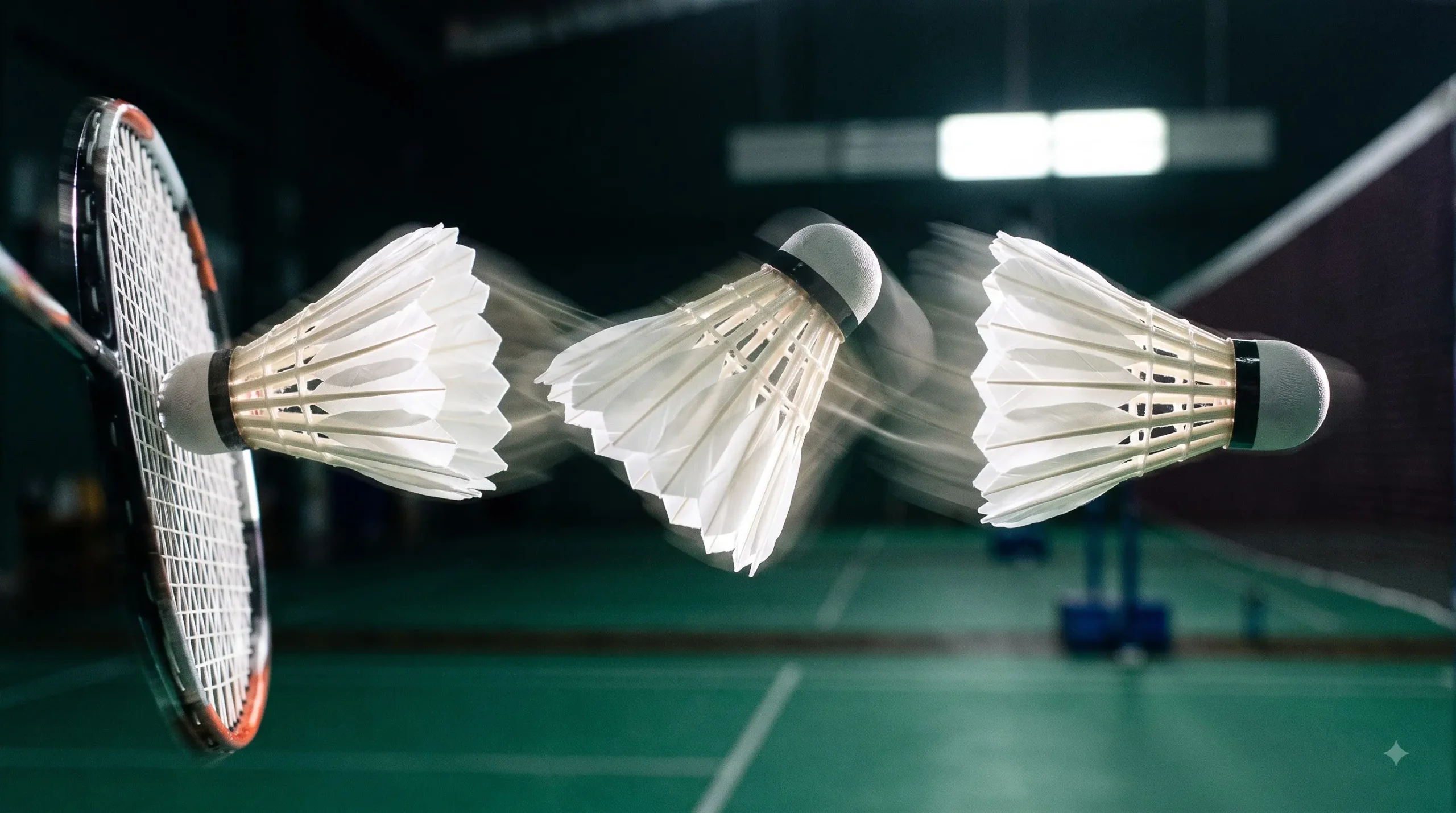
Often a shuttle is hit with the feathers facing the racket, which is the wrong way around. In about 20 milliseconds, it flips and points its cork forward. It then wobbles for around 80 milliseconds and settles. It never turns a full circle. It only turns the shortest way. That is faster than you can blink.
Why does it flip? Because the heavy point (the cork) and the point where air pushes (the feathers) are in different places. The air pushes the light feather end back, and the cork leads. It is like a dart or an arrow, but with a soft skirt.
2. The drag
The skirt of feathers catches a lot of air. This means a very high drag. Research says a shuttle leaving the racket at around 240 km/h loses most of its speed in only about 0.6 seconds and falls to about 25 km/h. That is why the shuttle drops steeply after a smash, and why you can never hit it out of the back of the court with pure power.
Scientists even call this the “aerodynamic wall”. After a certain speed, hitting harder will not make the shuttle travel farther. The air stops it. This is what makes badminton a game of skill and touch, not only power.
3. The spin
Because of the slight angle of the feathers, a shuttle also spins slowly as it flies. This spinning helps keep it stable on its way down, so it lands nose first and is easy to read.
Tesla vs Shuttle: A Simple Comparison
Let’s put the two side by side.
- What makes it fly: Tesla uses stored high pressure air and an electric pump. A shuttle uses the player’s swing and its own shape.
- Energy source: Tesla needs a tank, a pump and electricity. A shuttle needs nothing but you.
- Flight time: Tesla’s flight is a few seconds in a controlled stunt. A shuttle flies thousands of times in a single match.
- Stability: Tesla needs sensors and computers to control the flip. A shuttle flips and stabilizes itself in less than a tenth of a second, only by design.
- Weight: A Tesla Roadster is a car. A shuttle is about 5 grams.
- Cost of one flight: Tesla’s is a billion dollar science project. A shuttle costs a few riyals.
This is not to take anything away from Tesla. It is a fantastic piece of engineering. But the lesson is clear. The best flight technology is often the simplest one, where shape and materials do all the work. And a shuttle is one of the best examples in the world.
What This Means When You Buy a Shuttle
Now let’s bring this back to your court. Since the shuttle is only cork, feather and glue, the quality of each part decides how it flies. Here is how to choose the best badminton shuttles in the world, and the best ones for our region.
Check the cork
Look for natural cork, not foam sandwiched cork. A single natural cork piece holds its shape longer, so the shuttle keeps its flight even after many hits.
Check the feathers
Goose feather shuttles are the first choice for good players. Look at the skirt. All 16 feathers should be the same colour, the same size and evenly spaced. If it looks uneven, it will fly uneven.
Pick the right speed for the weather
Shuttles come in different speeds, often marked as 76 (slow), 77 (medium) and 78 (fast). Speed matters a lot, because air changes how a shuttle flies. Hot air is thinner, so there is less drag and the shuttle flies farther. Cold air is thicker, so it flies shorter.
This matters in the Gulf. Outdoor courts and warm halls make shuttles fly faster and farther. Many players here choose a slower speed in hot conditions, and a faster one in a cool air conditioned hall. If you pick the wrong speed, every clear will go long and your whole game will feel off.
Store them well
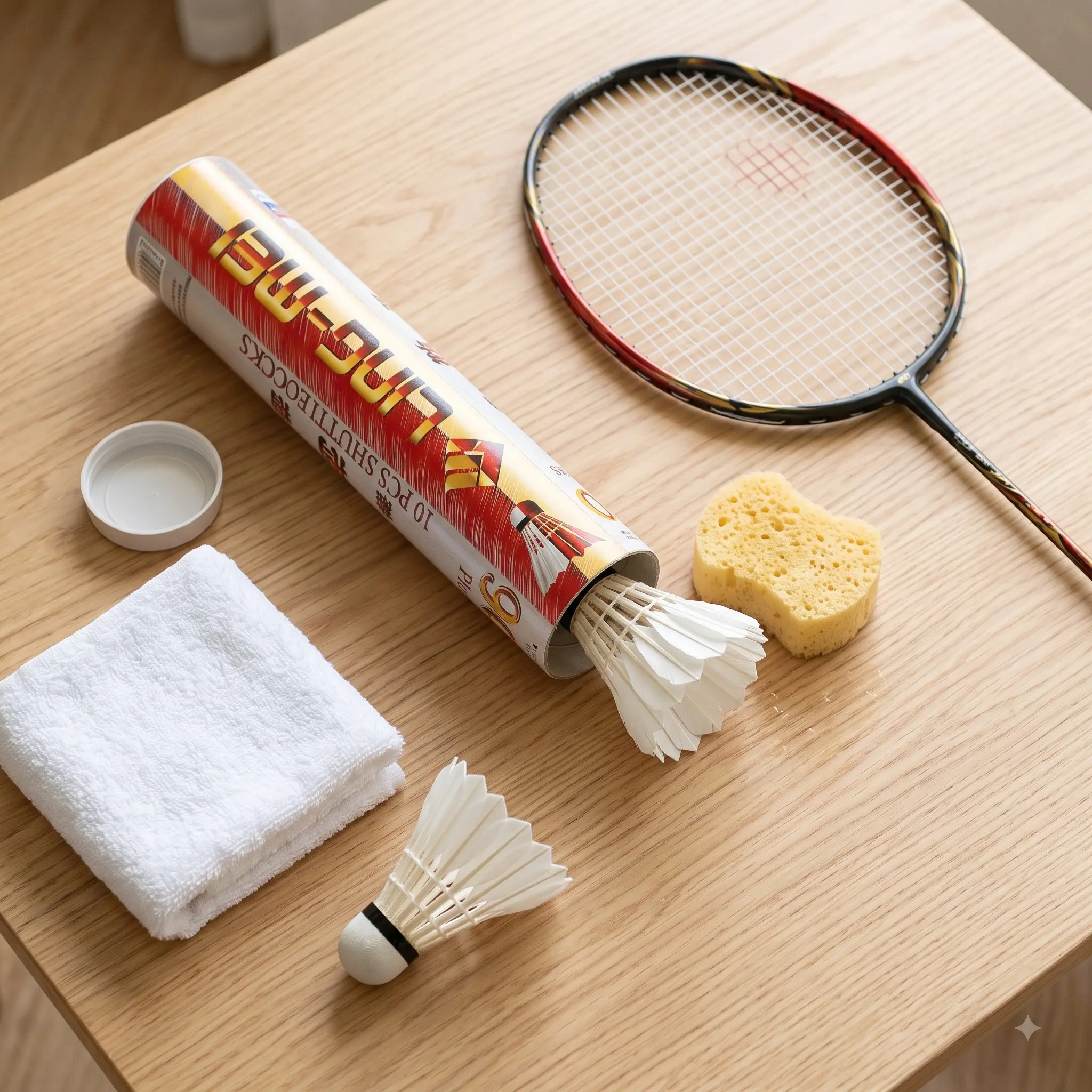
Feather shuttles are sensitive to humidity. If they get too dry, the feathers become brittle and break. Keep them in their tube and avoid leaving them in a hot car. Water on the cork is also not good. Many players keep a small damp sponge near the feather end of the tube, never touching the cork.
Match your shuttle to how you play
- Training and club play: Durable feather or a good nylon shuttle.
- Tournaments and serious matches: Top quality goose feather shuttles with natural cork.
- Beginners and kids: Nylon shuttles. They last longer and cost less.
Finding the Best Shuttlecock in Qatar and the GCC
Qatar and the wider GCC have a fast growing badminton community. Clubs, academies, corporate leagues and families all play. That means more players are asking the same question: where do I find the best shuttlecock in Qatar, and what is the best badminton shuttle in the GCC?
Here is a simple checklist you can use anywhere:
- Is the head made of natural cork?
- Are the feathers goose feathers, and are they matched?
- Is the speed right for the temperature where you play?
- Is it from a seller who stores the tubes properly, away from heat?
- Is it priced fairly for the quality? Very cheap feather shuttles are often a bad sign.
Use this list, and you will pick a better shuttle than most players do.
You can browse our badminton range at lingmeishop.com and choose the shuttle that fits your game and your court.
Frequently Asked Questions
Is the Tesla Roadster really a flying car? Not in the way a plane is. It makes short, controlled jumps using compressed air thrusters. The flying version is not approved for public roads.
What does a cold-gas thruster use for power? Stored high pressure gas. Nothing burns. The gas rushes out of a nozzle and pushes the car the other way.
Why do shuttlecocks have 16 feathers? Sixteen feathers form a skirt with the right shape for drag and stability. Fewer feathers change how it flies, and 16 is the standard for good play.
Why do shuttles slow down so fast? The feather skirt makes high drag. That is by design, so the game can be played on a small court.
Are goose feathers better than duck feathers? Goose feathers are usually stronger and last longer. Duck feather shuttles can be cheaper but are generally less durable.
Which shuttle speed should I use in Qatar? It depends on the hall. In hot conditions, many players choose a slower speed. In a cool air conditioned hall, a medium or faster one often works better. Test one tube and see where your clear lands.
Final Thoughts
Tesla gave the world a great show. Compressed air, strong tanks, electric pumps, fans and rocket thrusters all in one car. It is exciting, and it will push engineers forward.
But the shuttlecock has been quietly doing the same job for over a century with only cork, goose feathers and smart design. It flips itself, steadies itself and lands itself, with no battery in sight.
So the next time someone in your club says “did you see the Tesla flying car?”, you can smile and say, “Yes. But my shuttle flew first.”
Ready to upgrade your game? Visit lingmeishop.com and pick your next tube of shuttles.
SOURCES USED FOR FACTS
- Aviation Week, Tesla Demos Flying Roadster Powered By SpaceX Cold-Gas Thrusters
- NBC News, Elon Musk shows off ‘flying’ Tesla Roadster after years of delays
- New Atlas, Do the Tesla Roadster’s aerial stunts count as flying?
- Fox News, Tesla Roadster flies, flips and hits 60 mph in a flash
- Interesting Engineering, Elon Musk showcases Tesla Roadster ‘flying car’
- Bernama / dpa, Tesla Unveils Flying Roadster Sports Car
- Wikipedia, Tesla Roadster (second generation) and Rocket car
- Wikipedia, Shuttlecock
- Badminton Bites, How is a Feathered Badminton Shuttlecock Made?
- Cohen et al., The physics of badminton (New Journal of Physics) and Shuttlecock dynamics (Procedia Engineering, 2012)
- arXiv 2310.11155, shuttlecock drag and flipping